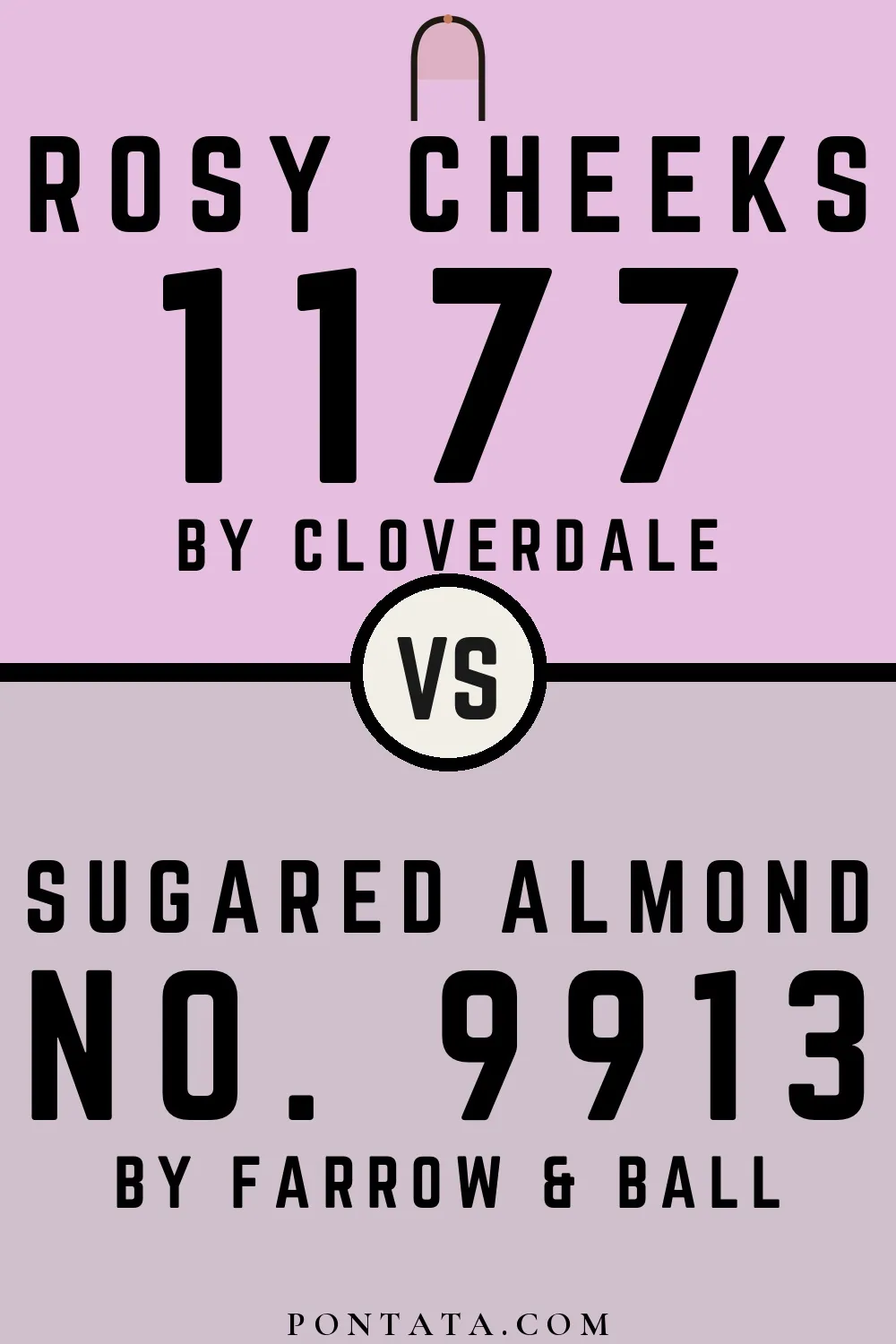
Rosy Cheeks vs Sugared Almond
Rosy Cheeks is a Cloverdale Paint color while Sugared Almond comes from Farrow & Ball. These are both pink-purples, so the question isn't which hue to choose — it's where within pink-purple to land. At LRV 59 vs 56, Rosy Cheeks will read as the brighter of the two — a 3-point gap that matters most in north-facing or low-light rooms. At ΔE 10.3, these are genuinely distinct colors — a strong contrast if used together, or a meaningful choice between two different directions. Below, 5 simulated room previews show how each color reads at scale — real-room photos will be added as they become available.
Color Details
Rosy Cheeks vs Sugared Almond Simulated Comparison
5 simulated room previews — drag the slider on each to see Rosy Cheeks on one side and Sugared Almond on the other.


Digital color is approximate. These simulations are generated from the manufacturer's hex values and overlaid on grayscale room photos — your screen's calibration, brightness, and viewing angle all affect how they render. Before committing to either color, test physical samples in your own space under the light you actually live with.
More Rosy Cheeks comparisons
See how Rosy Cheeks stacks up against other well-photographed colors across different brands and tones.


Ammonite reads slightly lighter (LRV 69 vs 59), a gap that shows most in low-lit rooms.


At LRV 83 vs 59, White Dove is decisively the brighter choice.


At LRV 59 vs 6, Rosy Cheeks is decisively the brighter choice.

Rosy Cheeks reads slightly lighter (LRV 59 vs 52), a gap that shows most in low-lit rooms.

Rosy Cheeks reflects far more light (LRV 59 vs 30), opening up a space where Evergreen Fog encloses it.

A 7-point LRV gap (59 vs 52) makes Rosy Cheeks the marginally brighter of the two.

With LRVs of 60 and 59, the two reflect almost the same amount of light.

Their light reflectance is nearly identical (LRV 59 vs 58), so neither reads brighter in a room.


At LRV 59 vs 27, Rosy Cheeks is decisively the brighter choice.

Rosy Cheeks reflects far more light (LRV 59 vs 43), opening up a space where French Gray encloses it.

Rosy Cheeks reflects far more light (LRV 59 vs 4), opening up a space where Naval encloses it.

A 4-point LRV gap (59 vs 55) makes Rosy Cheeks the marginally brighter of the two.

At LRV 59 vs 13, Rosy Cheeks is decisively the brighter choice.

At LRV 59 vs 44, Rosy Cheeks is decisively the brighter choice.

Pure White reflects far more light (LRV 84 vs 59), opening up a space where Rosy Cheeks encloses it.

Rosy Cheeks reflects far more light (LRV 59 vs 21), opening up a space where Artichoke encloses it.

A 7-point LRV gap (66 vs 59) makes Balboa Mist the marginally brighter of the two.

At LRV 74 vs 59, Shoji White is decisively the brighter choice.

At LRV 83 vs 59, Snowbound is decisively the brighter choice.

Rosy Cheeks reads slightly lighter (LRV 59 vs 51), a gap that shows most in low-lit rooms.

At LRV 59 vs 12, Rosy Cheeks is decisively the brighter choice.

At LRV 59 vs 8, Rosy Cheeks is decisively the brighter choice.

A 9-point LRV gap (68 vs 59) makes Skimming Stone the marginally brighter of the two.

Rosy Cheeks reflects far more light (LRV 59 vs 41), opening up a space where Dix Blue encloses it.


At LRV 59 vs 12, Rosy Cheeks is decisively the brighter choice.


At LRV 59 vs 45, Rosy Cheeks is decisively the brighter choice.


Rosy Cheeks reflects far more light (LRV 59 vs 31), opening up a space where Pale Green encloses it.