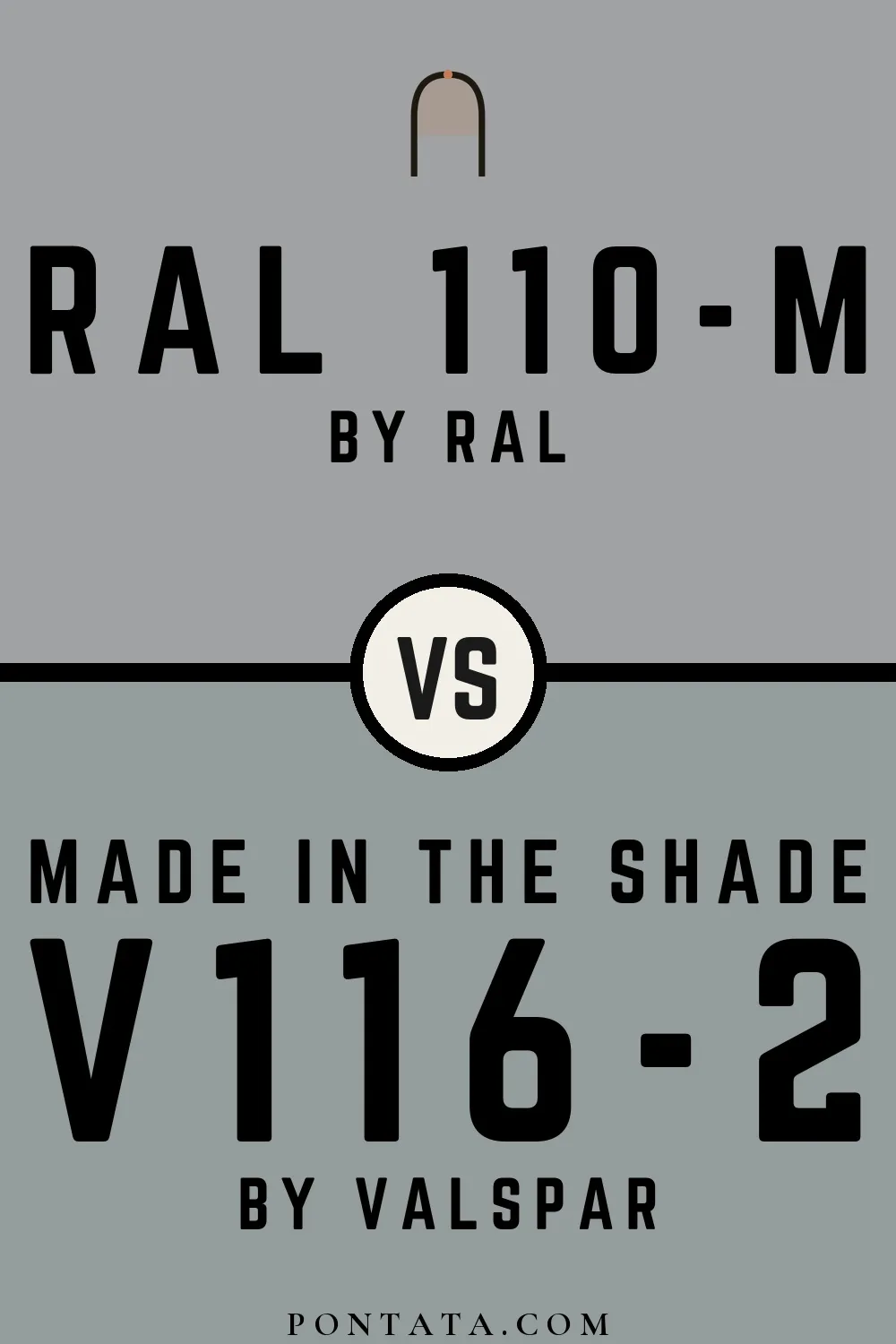
RAL 110-M vs Made in the Shade
RAL 110-M is a RAL Effect color while Made in the Shade comes from Valspar. Both sit in the grey family, which is useful context if you're narrowing within a single hue direction. At LRV 36 vs 33, RAL 110-M will read as the brighter of the two — a 4-point gap that matters most in north-facing or low-light rooms. At ΔE 3.5, the difference is perceptible but not dramatic — the two can work harmoniously in the same space. Below you'll find 1 real-room photo comparison where both colors appear side by side, plus 5 simulated room previews.
RAL 110-M vs Made in the Shade in Real Spaces
1 real room side by side. RAL 110-M and Made in the Shade are close enough that the difference can be hard to judge from a chip alone — these photos show how each reads at scale, across different spaces and lighting conditions.
Living Room
Living rooms test a color across a full range of conditions — morning sun, afternoon shade, and evening lamp light all shift how both of these read. RAL 110-M has the edge in reflectance, which shows as a quiet sense of added space rather than an obvious contrast.


Color Details
RAL 110-M vs Made in the Shade Simulated Comparison
5 simulated room previews — drag the slider on each to see RAL 110-M on one side and Made in the Shade on the other.


Digital color is approximate. These simulations are generated from the manufacturer's hex values and overlaid on grayscale room photos — your screen's calibration, brightness, and viewing angle all affect how they render. Before committing to either color, test physical samples in your own space under the light you actually live with.
More RAL 110-M comparisons
See how RAL 110-M stacks up against other well-photographed colors across different brands and tones.


White Dove reflects far more light (LRV 83 vs 36), opening up a space where RAL 110-M encloses it.


At LRV 52 vs 36, Purbeck Stone is decisively the brighter choice.

A 6-point LRV gap (36 vs 30) makes RAL 110-M the marginally brighter of the two.


At LRV 60 vs 36, Agreeable Gray is decisively the brighter choice.

Accessible Beige reflects far more light (LRV 58 vs 36), opening up a space where RAL 110-M encloses it.


RAL 110-M reads slightly lighter (LRV 36 vs 27), a gap that shows most in low-lit rooms.

A 7-point LRV gap (43 vs 36) makes French Gray the marginally brighter of the two.


Tranquil Dawn reflects far more light (LRV 55 vs 36), opening up a space where RAL 110-M encloses it.


Hardwick White reads slightly lighter (LRV 44 vs 36), a gap that shows most in low-lit rooms.

At LRV 84 vs 36, Pure White is decisively the brighter choice.


Balboa Mist reflects far more light (LRV 66 vs 36), opening up a space where RAL 110-M encloses it.

Shoji White reflects far more light (LRV 74 vs 36), opening up a space where RAL 110-M encloses it.


RAL 110-M reflects far more light (LRV 36 vs 12), opening up a space where Pewter Green encloses it.

RAL 110-M reflects far more light (LRV 36 vs 8), opening up a space where Duck Green encloses it.

Skimming Stone reflects far more light (LRV 68 vs 36), opening up a space where RAL 110-M encloses it.


RAL 110-M reflects far more light (LRV 36 vs 12), opening up a space where Vintage Vogue encloses it.


Saybrook Sage reads slightly lighter (LRV 45 vs 36), a gap that shows most in low-lit rooms.


A 5-point LRV gap (36 vs 31) makes RAL 110-M the marginally brighter of the two.