Match Salem Blue
PPG Salem Blue is a mid-tone shade with an LRV of 38. The matches below are ranked by ΔE, a perceptual color-difference score.
View full Salem Blue color page →
Closest matches across every brand
One match per brand, ranked by ΔE — a perceptual color difference score calculated from Lab color space values. Lower is closer. Click any card to compare side by side in simulated rooms.


With LRVs of 38 and 37, the two reflect almost the same amount of light. At ΔE 2.4 you'd need them side by side to tell them apart.


With LRVs of 38 and 38, the two reflect almost the same amount of light. At ΔE 3.6 they're clearly different, yet close enough to share a room.
A 6-point LRV gap (44 vs 38) makes Xavier Blue the marginally brighter of the two. The ΔE 4.2 gap is real but not dramatic — distinct as a choice, harmonious together.


Salem Blue reads slightly lighter (LRV 38 vs 28), a gap that shows most in low-lit rooms. At ΔE 4.9 they're clearly different, yet close enough to share a room.


A 8-point LRV gap (38 vs 30) makes Salem Blue the marginally brighter of the two. The ΔE 5.4 gap is real but not dramatic — distinct as a choice, harmonious together.


A 8-point LRV gap (38 vs 30) makes Salem Blue the marginally brighter of the two. The ΔE 6.2 gap is real but not dramatic — distinct as a choice, harmonious together.


A 6-point LRV gap (38 vs 32) makes Salem Blue the marginally brighter of the two. The ΔE 6.8 gap is real but not dramatic — distinct as a choice, harmonious together.


A 12-point LRV gap (38 vs 26) makes Salem Blue the marginally brighter of the two. The ΔE 6.8 gap is real but not dramatic — distinct as a choice, harmonious together.


A 9-point LRV gap (38 vs 29) makes Salem Blue the marginally brighter of the two. A ΔE of 11.4 puts them firmly in different territory — a strong contrast if combined.


Salem Blue reads slightly lighter (LRV 38 vs 29), a gap that shows most in low-lit rooms. At ΔE 12.4 these are two genuinely different directions, not variations on a theme.
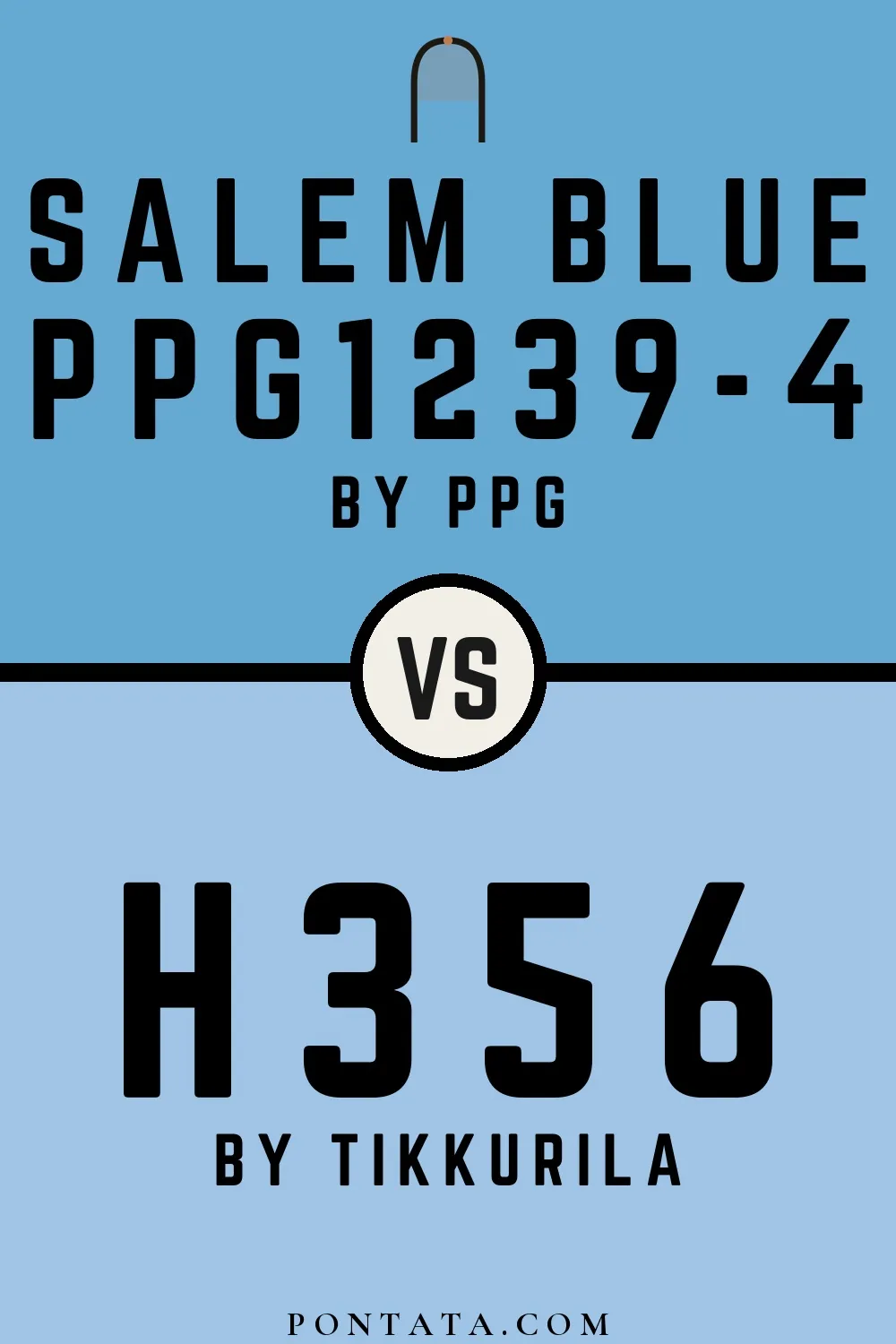

H356 reflects far more light (LRV 51 vs 38), opening up a space where Salem Blue encloses it. At ΔE 14.3 these are two genuinely different directions, not variations on a theme.


Their light reflectance is nearly identical (LRV 38 vs 36), so neither reads brighter in a room. A ΔE of 22.2 puts them firmly in different territory — a strong contrast if combined.


Their light reflectance is nearly identical (LRV 38 vs 38), so neither reads brighter in a room. A ΔE of 23.1 puts them firmly in different territory — a strong contrast if combined.


A 8-point LRV gap (46 vs 38) makes Driftwood Blues the marginally brighter of the two. A ΔE of 24.4 puts them firmly in different territory — a strong contrast if combined.